


Since the performance of videos and channels is closely tied to the YouTube algorithm, understanding how it works is extremely helpful.
In this article, we will do exactly that. We will reveal how the algorithm works, based on different reliable sources including YouTube itself.
Even though other social media platforms have always been very reserved about their algorithms, YouTube is quite open. Well, that doesn’t mean that the platform reveal every little detail. But, it does share enough for creators to understand what works and what doesn’t.
Let’s get started. By the end of this article, you’ll know all the secrets behind the YouTube algorithm and how to make it work for you.
“By the way, did you know that 70% of YouTube views come from recommended videos? For this reason, understanding the algorithm is fundamental for the growth of your channel”
In this article, we’ll cover…
- How does the YouTube algorithm work?
- Did YouTube change its algorithm?
- YouTube Algorithm Signals That Are Officially Confirmed
- Signals that YouTube’s Algorithm uses to evaluate videos (not confirmed by YouTube)
- Why Good Videos Fail On YouTube?
- How the algorithm works for each specific YouTube source
- How the YouTube Algorithm Works for Shorts
- Factors that DO NOT determine the algorithm
- How long does it take for a YouTube algorithm to work?
- What YouTube Says About Its Algorithm
- What do famous and successful YouTube creators say about the algorithm
How does the YouTube algorithm work?

Generally speaking, YouTube’s algorithm presents users with a mix of their favorite videos and those most relevant based on their recent viewing history. Consequently, recommendations are personalized according to each user’s preferences and followed channels.
The reason for this is that by helping users find videos they are more likely to like, YouTube can keep viewers on the platform as long as possible. Plus, this can motivate them to return to the site regularly.
This is why YouTube takes its algorithm seriously, and the goal is clear: offer each user the best, customized experience.
At this point, you might be wondering how understanding the algorithm can benefit you.
But, don’t worry. There are major factors that are under your control and that you can use to trigger the algorithm and help your channel. And we will see them one by one.
But before we start, here is something you need to know.
Videos appear in five sections, which we rank by importance: Recommended videos, Homepage, Search, Subscriptions, and Trends. The ranking is based on each section’s ability to generate new visits.
A video that is shown repeatedly in recommended videos reaches many more new visitors than a trending video for a few days.
Want to know how to find a trending topic for your next video? Check out our blog on how to find trending topics for your YouTube video.
Therefore,the order we will discuss is also the order in which each source gets more traffic on YouTube; as we said, the suggested video is the king with over 70% of the total traffic. We will also cover the YouTube Shorts algorithm.,
Did You Know?
According to Google’s 2024 Q3 earnings call, almost 70 billion Shorts are watched daily.
Did YouTube change its algorithm?
As you may have noticed, YouTube does not stay the same. The recommended videos may change over time as YouTube updates its algorithm. Although the algorithm still serves the purpose of recommending videos to you, it is occasionally updated to provide better results and keep users on the platform for as long as possible. Some of the key updates YouTube has made on its algorithm include:
- In 2015, YouTube formalized user satisfaction as the most important metric in ranking and recommending videos. This meant that YouTube would recommend videos based on the individual user’s behavior.
- In 2016, YouTube announced that it uses deep neural networks to control recommendations. They started making more relevant video recommendations to the users.
- In 2019, YouTube increased demonetization for content that was considered unsafe or improperly categorized for younger viewers.
- In 2024, YouTube made additional changes to the algorithm to make the platform safer for users. One of the main changes was to include guidelines for more responsible content, particularly for health and news topics, while also reducing the spread of harmful misinformation.
- That’s why, factors such asengagement, relevance, watch time, and user preference are still critical in video recommendations. A video that gains more views and engagement through real likes or shares is also promoted further by the algorithm.
Signals that YouTube’s Algorithm uses to evaluate videos (confirmed by YouTube)

YouTube uses many signals to evaluate videos and rank them in its algorithm system. All of them notify the system about what users find satisfying. Check out the main metrics that the system relies on:
1. Clicks
2. Watch time
3. Survey responses
4. Shares, Likes and dislikes
5. Returning visitors
6. Channel’s niche, overall health, and authority
1. Video clicks (CTR)
Reason: “Clicking on a video is a strong indicator that you will enjoy it as well. After all, you wouldn’t choose to watch something you didn’t want to see”, explains YouTube.
What we learn from it: CTR is therefore very important, and so is the choice of engaging titles and thumbnails.
CTR is the percentage of people who click on your video after seeing it. It is measured in all internal YouTube traffic source, from suggested videos to YouTube searches. Each of them is considered differently. For instance, a good CTR from the YouTube search will increase the ranking of a video for specific keywords, while CTR from suggested videos will lead to YouTube suggesting your video even more.
Did You Know?
Half of all YouTube videos and channels have approximately 2-10% CTR.
But, of course, clicks (CTR) can’t be a standalone signal. This is why, for several years, YouTube implemented another crucial signal. See below.
Remember, the video click-through rate is the most important signal that the algorithm considers when ranking and recommending videos to users. YouTube considers clicking on a video a strong indicator that the user finds it attractive or enjoys watching that kind of content. If you are a content creator or marketer, you must consider making your videos attractive for the first impression. Choosing engaging titles and attractive thumbnails that will prompt users to click.
CTR Paradox: Why A Low CTR Can Also Be A Good Signal?
Wait, can a low CTR be a good sign? Actually, yes. It sounds counterintuitive, but recent insights from YouTube’s Creator Insider team reveal a ‘success paradox’ due to this reason:
- When a video starts performing incredibly well, the algorithm pushes it to a much wider audience, who don’t know you yet and aren’t familiar with your content. Naturally, these cold audiences are less likely to click than your loyal subscribers.
- So, as your distribution widens (more views), your CTR often drops. If you see a dip in CTR on a video that is gaining views, don’t panic! It is often a consequence of success: you are breaking out of your bubble and reaching new people.
2. Watch time (audience retention)
Reason: “Your watch time – meaning which videos you watched and how long you watched them – provides personalized signals to the algorithm about what you most likely want to watch” So if a tennis fan spent 20 minutes watching NBA highlights and only a few seconds watching match analysis video, the algorithm can safely assume that user(s) found the highlights more valuable.
What we learn from it: Watch time is the amount of time users spend watching your videos. In other words, for how long can your video retain users on the YouTube platform? In addition to making your video attractive for clicks, you also need to provide engaging and relevant content that will keep your viewers engaged to watch your video for longer.
Did You Know?
The average retention rate on YouTube is about 50-60%. That means you must aim to keep at least half of your viewers hooked throughout the video.
Content is pretty crucial for that. Focus on providing engaging and relevant content that will keep your viewers hooked as much as possible.
If you are thinking of increasing your video’s reach by purchasing YouTube views, watch time is a major factor to consider. Since audience retention is such an important metric, make sure to either use advanced targeting – i.e. with Google Ads – or use high retention views.

Absolute vs. Relative Watch Time
A common worry among creators is: “Does a 15-second Short with 90% retention beat a 20-minute video with 30% retention?”
YouTube clarified that they look at Absolute Watch Time (total minutes) just as much as, if not more than, relative percentage. This ensures fairness. It’s easy to get a high percentage on a very short video, but much harder on a long one.
Since YouTube’s goal is to keep people on the platform, a user spending 10 minutes with you (even if that’s only 50% of your video) is often a stronger signal of interest than a user spending 10 seconds with you (even if that’s 100% of the clip).
3. Survey responses
Reason: This is what we, at YouTube, call “valued watch time”. It is the time spent watching a video that you consider valuable. The main idea behind the metric is to ensure that viewers are truly satisfied with the content they’re watching.
Did You Know?
YouTube tracks valued watch time through user surveys in which you rate the video on a scale of one to five stars, and how it made you feel: was it inspiring or meaningful? Only videos with four or five stars that you rate highly are counted as valued watch time.
What we learn from it: YouTube is moving in a direction where they want to provide real value and emotions to viewers. Therefore, videos that “hit the right cords” in viewers, meaning emotional response or value, will result over time in higher exposure. On top of that, such videos also tend to have more shares, which is another signal that the YouTube algorithm takes into consideration.
In the video survey responses, YouTube considers how they feel about specific videos. For content creators, this means offering videos that go beyond being attractive to click on, but also entertaining and engaging.
4. Shares, likes and dislikes
Reason: “People are more likely to be satisfied by videos that they share or like, on average. Therefore, this data (shares, likes) is used by the algorithm to predict the likelihood that you will share or like additional videos similar to that. If you dislike a video, it’s a sign that you probably didn’t enjoy watching it.”
What we learn from it: There has always been a debate, but YouTube confirmed many times, that indeed likes are taken into consideration when ranking a video. For this reason, also asking for likes, or sharing a video all over social media will have a positive benefit on our channel’s ranking.
Therefore, don’t be shy to ask for likes, shares, and comments. And even if you don’t use voice-over in your videos, no worries. You can use YouTube call-to-action animations which, in a fancy way, will visually remind your viewers to engage with your video.
If you want to invest in your channel, you can also think of purchasing shares and real engagement. Just make sure to keep it real, by getting real social media shares which can both drive traffic and have a positive impact on the algorithm.
Did You Know?
YouTube also explained that when it comes to likes and dislikes, not all likes are the same. For instance, a like from a person who likes every single video who watched on YouTube, will not have the same value to the algorithm as a like from someone who rarely leaves a like on a video.
The way the YouTube algorithm for views works is quite impressive. While we may not exhaust every component when promoting your video, we always make sure to cover the basics. Focusing on the most important aspects will see your video getting more views and subscribers. As far as the signals that the algorithm uses, some have been confirmed by YouTube while others are just speculative.
Signals that YouTube’s Algorithm uses to evaluate videos (not confirmed by YouTube)
· Channel’s frequency of upload
· Prolonged experience on the platform
Now that we learned about the overall most important signals, it’s time to break down how ranking happens in different traffic sources on YouTube. And, after that, we will debunk some of the most common myths on factors that actually do NOT affect the YouTube algorithm, contrary to what most people believe.
Why Good Videos Fail On YouTube?
Ever thought of this: “My stats are great, so why are views low?”
Sometimes, you might tick all the boxes (great CTR, high Average View Duration), but the video still doesn’t fly. It can be frustrating, but YouTube explains that algorithms don’t exist in a vacuum. Even with perfect stats, three external factors can cap your views:
- Competition: Even if your video is a 10/10, if a competitor uploaded a slightly better video (or one with a better thumbnail) on the same topic at the same time, they might win the impression.
- Topic Interest: You cannot force demand. As YouTube notes, “There are more people interested in football than in golf.” A football video with average stats might still get more views than a golf video with perfect stats, simply because the potential audience pool is larger.
- Seasonality: A video about Christmas Gifts will likely see low engagement in July, regardless of how high the quality is. The algorithm knows when viewers are historically interested in specific topics.
How the algorithm works for each specific YouTube source
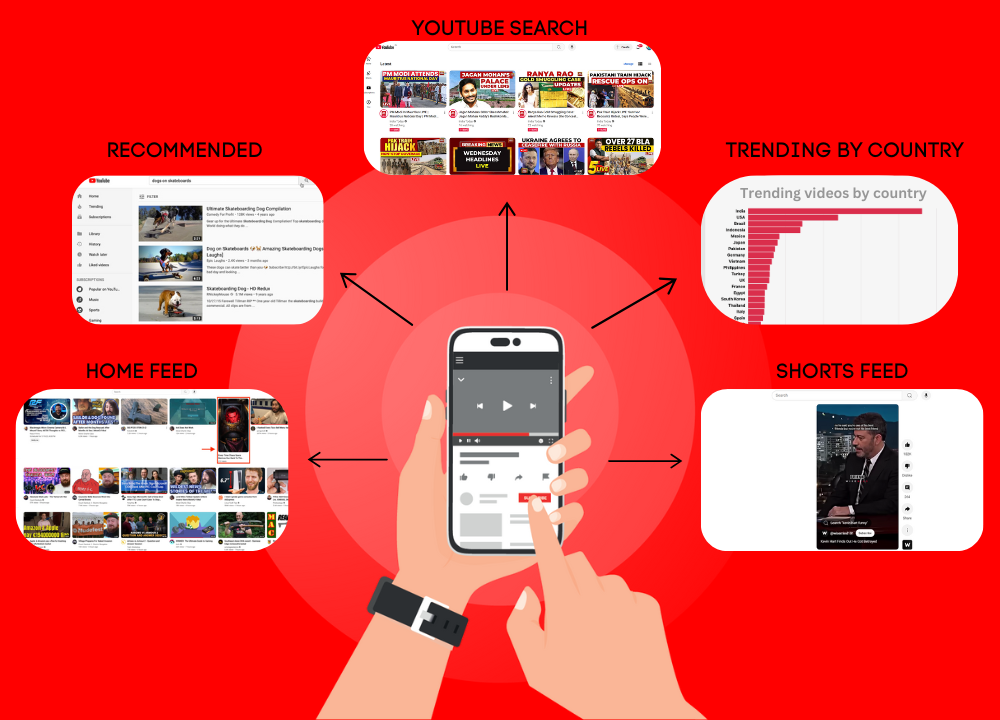
As you know, videos can reach viewers from different sources and tabs on YouTube. And, for each one of them, the algorithm uses slightly different formulas to decide which videos to suggest or rank. Even with YouTube Shorts, the algorithm is different to ensure users get a unique experience when scrolling through the Shorts feed. The traffic sources we will see more in detail now, are:
1. Recommended videos (70% of traffic, including home feed suggestions)
2. Home feed
3. YouTube search results
4. Subscriptions
5. Trending videos by country
6. Shorts feed
Just like the Instagram algorithm, the use of algorithms on YouTube allows the platform to control the mode of discovery in each category. This means that all YouTube algorithms are impacted by different signals, which tell YouTube how valuable a video is and the kind of content users want to see more of. Let’s explore how each of the algorithms plays out:
1. Recommended (suggested) video algorithm
Two different users will never have the same YouTube experience. To each user, YouTube shows the personalized and most relevant content. To do so, the algorithm analyzes hundreds of videos that the user has previously watched and how the user interacted with them to find new content that may be of particular interest to them.
YouTube videos are recommended on the right side of the screen alongside the video you are currently watching. These videos are ranked based on what you are most likely going to watch next. Although the suggested YouTube videos are related to the video you are currently watching, the algorithm often personalizes them based on watch history. Users also have the option to filter suggested video feeds based on factors like:
· From (Creator they are currently watching)
· Similar artists
· Related
· Watched
· Recently uploaded
Videos recommended by the Suggested Video algorithms are governed primarily by user behavior. YouTube has clearly stated that they track what viewers watch, how long they watch what they skip over, and more. Based on this data, the YouTube algorithm can figure out what kind of videos a user likes best and what can be recommended to them next.
Parameters deciding what if a viewer liked the video
YouTube needs to find out what a viewer likes in order to recommend videos to them. The algorithm considers how a viewer interacts with a video based on the following parameters:
· What the user watched
· What the user did not watch or skipped
· What they searched for
· How long the user watched the video (audience retention)
· If the user liked the video and most importantly, shared it or subscribed to the channel afterwards.
· If the user saved the video to a playlist
· If the user came back to watch the video (if they watched the video more than once/returning visitor)
· If the user engaged with other videos on the channel
· If the user provided a “Not Interested” feedback
Common Interests
Apart from what a user likes, the YouTube algorithm will also take into consideration what people who watch the same content or channels as you do, also enjoy watching. In other words, YouTube tries to find people with common interests and then uses the information to suggest new videos.
If you think about it, you surely have noticed a few times a notification on your watch page saying something like “users who watch channel x, are also watching channel y”. That is just another proof of YouTube implementing this mechanism into his algorithm. In fact, this aspect was also recently confirmed by YouTube’s VP of engineering.
“Our system then compares your viewing habits with those that are similar to you and uses that information to suggest other content you may want to watch.”
– Cristos Goodrow, VP of Engineering At YouTube
Let’s say you love watching videos about dogs. YouTube notices that most people who love watching dog videos, also enjoy watching Tennis videos. In that case, even if you have never watched a Tennis video before, YouTube will sooner or later show you one video about Tennis.
YouTube doesn’t rely only on user’s watch history, preferences, and people who share common interests. It also takes into account the video’s social proof. It simply means how much a video has been appreciated by the average spectator. That means the general liking of that video.
Content creators can use several approaches to gain social proof for their YouTube videos. The most obvious approach is building trust and credibility by sharing positive experiences of your product and services.
This is why in addition to “personalized” videos, YouTube recommends videos related to the topic (category) of the video that the user is watching or usually watches, which are viral or have been appreciated by other users, using metrics such as retention, shares, etc. to evaluate them.
YouTube recommends multiple channels

YouTube also explained how it is more efficient for their algorithm to show videos from different channels. So, it tends to recommend videos from multiple channels even on the same content category. This is great news as it means that everyone has space even if the competition is pretty high.
And, you can surely confirm this statement yourself as well. Try to go on YouTube, and watch 3 or 4 videos from the same channel in a row. Even then, in the suggested videos, YouTube will show you just a few videos of that channel at most, and other videos from a variety of similar channels.
So, the golden advice here is to specialize your channel in a specific topic (this will increase the authority of every single new video) and every now and then, take a look at popular channels that upload videos on the same topic and try to understand what makes them popular. Then, replicate a similar content creation strategy to boost the performance of your own videos.
2. Home feed algorithm
The second most popular source of YouTube views is a user’s home feed (on mobile) or homepage, on desktop. The home feed is a mix of the user’s subscriptions, videos suggested by the algorithm according to the user’s specific preferences, and watch history, news, and a few trending videos. So, we can’t really break down this category as it is a mix of other sources discussed in this article, and their principles apply, especially the ones from suggested views.
“Your homepage is what you see when you first open YouTube and it displays a mixture of personalized recommendations, subscriptions, and the latest news and information.” – Cristos Goodrow, VP of Engineering At YouTube”
YouTube describes “Home” as where the displayed videos are the ones from the channels the user has subscribed to, new videos, as well as videos watched by similar viewers. The selection of videos that get displayed on home is based on:
| Factor | Explanation |
| Performance | How well a video has interested and satisfied similar viewers, and other factors. |
| Watch And Search History | How often the user watches a channel or topic, and the number of times the YouTibe has already shown the video. |
3. Search on YouTube Algorithm
YouTube search is the third biggest source of YouTube traffic. It is quite important because YouTube search brings highly targeted YouTube visitors, who get to watch exactly what they were looking for, and not what someone else suggested to them. For this reason, despite being a secondary source, it is important to understand how it works, as no other viewer converts as good as the ones coming from a YouTube search.
Despite being relatively a smaller search engine, YouTube is big in terms of content availability. After all, YouTube is owned by Google and their search engine is optimized for results.
Keyword
Just like Google’s search engine, YouTube strives to surface the most relevant results to a user based on their keyword searches. However, the search results are not a list of the most-viewed videos for the search, but the most relevant ones. For this, YouTube considered the following factors:
· How well the title, description, and video content matches the user’s search
· What videos drive the most engagement for a search
The two factors that most influence the position of your video on YouTube search results (but in general of any search engine) are:
| Factor | Explanation |
| Keyword | YouTube considers how the video’s title and keywords match the query made by users. |
| Relevance | Check whether the video is relevant to the user search. |
Keywords include tags, description and above all ‘title’. This is quite obvious in a way, since if a user types on YouTube “Funny dog compilation”, he wants to see a funny compilation about dogs, and not how to play with your cat.
It is important to use the keywords that the people will search for. Put them in your video titles and possibly in your tags and description too. That’s because, when ranking videos on YouTube search results, YouTube considers how the video’s title and keywords match the search made by users. You can use our dedicated YouTube video title generator to create SEO-optimized title for your videos within seconds.
Another important thing is to select clear and relevant keywords. Try putting yourself in the shoes of the user who decides to do a search query. For example, I made a video that explains how to cook a risotto. Now think about what words a user can use to search for that video. One word he can use is “risotto recipe.” So you can use this word as a keyword and put it in the title and in the metadata of your video.
You can use our dedicated YouTube keyword volume checker to find the best keywords for your videos. Just type in the topic and the tool displays the search volume, difficulty, and even the search trends.
Other important factors
And what is really interesting to us are the secondary factors, which we can use to outrank all the other videos with the same keywords. What we mean is that other than keywords, YouTube also considers many factors, such as how many videos the user has watched from your channel in the past, the channel’s niche and the authority of the channel. And if these factors are in your favour, your video is going to rank better than those with the same keyword.
The other factors which determine YouTube search ranking are::
| Factor | How It Affects? |
| Click-through Rate (CTR) | Shows YouTube that your video is exactly what your audience was looking for. |
| Last click | The last click is the final video a user chooses after skipping others, and it signals to YouTube that the viewer found what they were looking for. The algorithm prioritizes that video for similar users in the future. |
| Audience Retention | The amount of time of the portion of your video that users view on average. |
| Likes, Shares, and Saves | The number of likes, shares, and saves indicates how valuable the viewers found the video to be. |
| Video signals and their keywords | Embedded video, shares, and playlist in which it is present. |
If we were to consider two videos with similar content and targeting similar keywords, CTR and last click are the most important factors used by YouTube to rank a video. For this reason, we developed the YouTube SEO ranking service to help you achieve better ranking with your content. No need to search for ‘YouTube marketing’ on YouTube or go through lengthy tutorials. You got Lenos for that ;)
4. Subscriptions page and how it can trigger the algorithm
YouTube has a “subscriptions” page where the user can see all recently uploaded videos from the channels they are subscribed to (as well as posts and stories).
But subscriptions are not only a way to get views from users already subscribed to the channel, but also a way that YouTube uses to rate newly published videos through a metric called “views velocity“, which measures the number of subscribers who watch your video that has just been released.
The higher the view velocity, the higher the positioning of the video.
Therefore, the subscription source is particularly important for established creators with an active subscriber base, as it can make (or break) a freshly uploaded video. But, mostly, it can help to give a little boost to new videos, if publishing is done right. If you are just starting out and struggling with finding followers, buying real subscribers can give you a much-needed boost.
A tip is, therefore, to publish videos at times when subscribers are particularly active and possibly always at the same time and/or day. So, subscribers know when the video is published and respond in a more reactive way. Another way is to notify users before uploading, via a post, story, or previous video.
And, of course, a catchy thumbnail! ;) Always, always use a great thumbnail.
5. Trending videos tab
The trending page collects new and popular videos from a specific country. In this section YouTube tries to balance news videos, popular topics and content from different niches.
Unlike the other categories, YouTube’s Trending feed is not personalized based on user behavior. Instead, the feed is determined by the most popular videos or Shorts in a user’s country at a specific time. You will also notice that this feed is quite dynamic as the list continuously refreshes every 15 minutes, updating the videos being shown.
For trending videos, the speed of growth and sharing is therefore particularly considered. That being said, unless a video is shown at the top of the trending tab (Top 6 positions mostly), it is not really a source of traffic to aim for.
Even so, we agree that having a video on the trending tab is satisfying and no wonder many clients asked us to help them get their videos to trending. Although the YouTube trending algorithm is comparatively straightforward, there are certain factors critical in determining which videos and shorts make it to the list. These include:
| Factors | Explanation |
| Views | How many users viewed the content? |
| Age of the Video | When was the video uploaded? Newly published videos are always preferred. |
| Source of Traffic | Where views are coming from( including outside of YouTube)? |
| Traffic Growth | How quickly a video is generating views |
| Performance | How the video performs compared to other recent uploads of the same channel |
YouTube says that they combine these signals to produce a list of videos that display what is happening while ensuring the content is relevant to viewers and a reflection of the content on the platform. This means that the video that has garnered the highest view count in a day may not necessarily be the #1 trending video. In most cases, videos with more views tend to be shown below videos with fewer views.
YouTube uses this approach to ensure the relevance of the content being showcased. To keep viewers safe, YouTube has integrated strict controls for the trending videos section. Specifically, videos that contain mature content, excess profanity, violence, or videos considered inappropriate like those disparaging others in the community are automatically excluded in the Trending section.
For the trending section, view velocity—views per hour since upload—is crucial. Consider boosting your video’s view rate. At Lenos, you can buy YouTube views that are fast and from real users.
YouTube algorithm for shorts

YouTube Shorts are short-form, vertical videos for 60 seconds or less, similar to Instagram Reels and TikTok. Designed for viewing on mobile devices, the approach to which Shorts are recommended is slightly different from standard long-form videos.
With long-form videos on YouTube, users proactively choose the video they want to watch. The YouTube algorithm suggests the video they are likely to watch next. The YouTube Shorts, on the other hand, serves users new videos in a continuous feed. Users simply swipe their screen to see the next video in the queue, leaving the decision of what to watch next entirely to the algorithm.
The YouTube algorithm for Shorts uses signals such as user behavior and video topics to forecasting the videos the user is likely to enjoy watching. The most important factors include:
| Factors | Explanation |
| Views | The algorithm measures the percentage of times viewers watch your Shorts content in full. If more people swipe away from your videos before completing them, the algorithm will serve less of your Shorts to others |
| User Watch History | User’s behavior determines the kind of videos YouTube shows them. Viewers who never swipe from home DIY videos or cooking videos will see more videos on those topics |
| Engagement | When a user engages with a type of Short, the algorithm serves them more videos in that category |
| Relevance | The YouTube algorithm for Shorts serves videos that it believes are relevant to the user’s interests and niche. |
The unique way the YouTube shorts algorithm treats videos allows for a personalized experience. With Shorts, it can take a short time like 60 seconds for a video to explore in views and start trending. Aligning your content creation and marketing strategies with the algorithm standards can help you grow your YouTube channel significantly within a relatively short time.

Check out a summary of how the algorithm works for each source and the main factors considered:
| Source | How Does The Algorithm Work? | Main Factors Considered |
| Recommended | Suggests videos based on the watch history of the user. | What the user watched. What the user did not watch or skipped. What they searched for. How long the user watched the video (audience retention)If the user engaged with the video · If the user provided a “Not Interested” feedback |
| Home Feed | Personalizes content based on past watch behavior. | Performance Watch And Search History |
| YouTube search results | Ranks videos based on keywords and user engagement signals. | Keyword Relevance |
| Subscriptions Page | Displays videos based on the ratio of how many subscribers have viewed it. | Viewer velocity |
| Trending Videos | Showcases popular videos with high shares. | Views Age of the video Traffic Source Traffic Growth Performance |
| Shorts | Uses watch time and engagement. | Views User watch history Engagement Relevance |
Factors that DO NOT determine the algorithm
Now, this is important. And not just to debunk, but also to help you relax and not worry about certain things (or not obsess too much, as they are not relevant to the algorithm!). It helps you to understand what to focus on when creating content and stop worrying about certain things that really do not matter.
Contrary to what many think, the following factors do not affect the YouTube algorithm for views.
· Monetization: As specified by YouTube, whether you have a channel with monetization or not, does not affect the algorithm. YouTube says that “after a channel’s monetization gets disabled there is no difference in how the channel’s videos are promoted in search results and the recommendation system”
· Likes and comments: Unlike other social platforms, the number of likes and comments (also known as the engagement rate) has very little influence on the YouTube algorithm. However, shares of the video are taken into consideration.
· Receiving Copyright Warnings: Receiving a removal notification on your channel for copyright infringement or third-party complaints (e.g. music featured in the video) does not harm the positioning of the channel or a video.
Also Read: YouTube Copyright Strike VS Copyright Claim 2025: All You Need To Know
– Poor Performance from External Links: Creators often worry that sharing their video on social media or blogs might hurt them. The fear is that external users might click, watch for 5 seconds, and leave, affecting the retention stats. YouTube has confirmed this is false. The algorithm evaluates performance in context. It knows that Home traffic behaves differently than Facebook traffic. Poor retention from external links will not hurt how your video is recommended on the Homepage or Up Next.
How long does it take for a YouTube algorithm to work?

If you are a content creator and just submitted a video, you may wonder how long it takes for YouTube algorithm to work. Generally, the first 48-72 hours of a video’s life on YouTube are critical to its success.
This is the period when the YouTube algorithm may identify your video for the very first time and test it out with various audience types. However, most successful YouTube channels grow in an S-shape curve as the algorithm is constantly working. The video will start with a slow initial growth that is often followed by rapid growth.
The way the algorithm works is not clearly set in stone as each video will usually grow different. However, it usually takes 3-5 days for the algorithm to test the water with your video. During this period, the video will be sent to different audiences with different focuses to determine where it is considered most relevant. If more people watch the video, the algorithm considers it valuable to that audience type and recommends your video more to them.
What YouTube says about the algorithm
The YouTube algorithm is mostly concerned with user behavior over any other factors. It monitors the way viewers engage with videos—watch time, likes, shares, comments, and even where they drop off—to decide what should be suggested. Even though tags and titles are still important in helping the algorithm get the video context, it is these viewer metrics that play a pivotal role. YouTube says that it does not “read” the content of the videos and the algorithm relies only on the video’s performance.
“Believe it or not, our algorithm doesn’t have an opinion about the content you make. It actually focuses on what your viewers might enjoy based on things like videos they’ve watched, how long, shares, likes & dislikes, and feedback.”
YouTube
CTR (users’ frequency of clicking on a video when they see it in their feed) and watch time (how long they watch it) are the main metrics that the algorithm considers. YouTube, though, balances them precariously—if a video performs well in CTR but has poor watch time, it might be clickbait, and the system will suppress it.
But that doesn’t mean that the system is purely confined to a set of metrics. Rather, it even considers viewer happiness through surveys, likes, and dislikes. The system also continually adjusts in response to the audience. A newly uploaded video can be initially tested against a small audience and, if it works well, is presented to more users.
Even the device and time are also significant in the recommendation system. YouTube applies these signals to learn viewer tastes in various contexts. For example, viewers may like news during the morning and comedy during the evening. Similarly, they consume different content on TV versus mobile phones. The system learns these behaviours and adapts recommendations accordingly so that the proper content is presented at the right time.
In fact, the recommendation algorithm has made the platform so personalized that it brings up content specific to each viewer based on their history of watching and engagement. Two individuals looking for the same subject might receive different results since the system adjusts to personal preferences.
YouTube has even added several large language models (LLMs) to its recommendation system to balance several factors for recommendation. Thus, there is no one metric that promises success. Creators need to focus on enhancing their content according to their own audience’s preferences instead of pursuing common benchmarks.
YouTube is also working to remove the guesswork from your strategy. Recently, they’ve created a new A/B thumbnail tester tool, which will allow you to upload multiple thumbnails and let the system tell you which one gets the most clicks. They are also developing a comparison tool for CTR and AVD to help you benchmark your channel against similar creators in your niche.
If you want to get some more information regarding the algorithm by YouTube, we suggest watching the video below. It’s a few years old, but the information is still relevant and helpful for content creators.

What do famous and successful YouTube creators say about the algorithm
Anonymous YouTuber
The YouTube algorithm is a bit of a matchmaker—it tries your video on a small group of people first, such as your subscribers or viewers with similar tastes, to gauge their response. If they click and watch (with good duration), YouTube becomes confident enough to show your video to more people. This begins with recommended videos, where your video is shown underneath other people’s content. If it does well there, it gets sent to the browse tab, where impressions are more specific. By this point, YouTube has a clear idea of who to expose your video to, so CTR and watch time tend to get better.
But YouTube doesn’t leave it at that. It continues testing your video on new audiences, even months or years down the line. If it discovers a new audience that resonates and views, your video receives a second life with thousands of new impressions. Yet, if your video fails to attract an early audience—due to bad production or a subject of niche appeal—it may languish with isolated impressions.
SEO and marketing off-site help, but finally, YouTube does best with what it deems best quality and relevance.
Even with a great grasp of the algorithm, you’re not automatically guaranteed success. You still have to have awesome content that resonates with lots of people. The algorithm is just a tool. Your creativity and relationship with your audience are what really get a channel going.
Channel Makers
The main task of the YouTube algorithm is to determine who your audience is. When you begin a new channel, YouTube doesn’t know who your content is for. So, it tests very carefully. If your video receives clicks and watch time, YouTube becomes more confident and displays it to more people.
But if your videos are scattered in terms of content, YouTube finds it hard to identify your audience, and your channel will grow slowly. To accelerate this, concentrate on a niche. This enables YouTube to easily identify your audience profile, and your videos will find it easy to reach the appropriate viewers.
Search is a strong weapon for small creators. Unlike the homepage or suggested videos, search doesn’t depend on YouTube understanding your audience. If your video solves a trending question, it can rank fast, even on a new channel. This provides YouTube with early information to know who your content is for.
Focus on your value proposition, and the algorithm will take care of the rest.
As your channel grows, stay consistent with your niche. Take the case of successful YouTube channels like Mr. Beast. They all maintain a definite theme. This narrow focus makes YouTube well aware of who to suggest their videos to.
Ultimately, it’s all about two things: assisting YouTube in understanding your viewers and producing content that connects with them.

Nolan Molt (Think Media)
The YouTube algorithm is all about understanding your audience and delivering content they love. You need to keep them engaged.
Your thumbnail is the first chance for that. Is it attractive enough to stop someone scrolling? If 10 out of 100 people click on your video, you’re on the right track. But clicks alone aren’t enough. When they do click, you have to keep them viewing. Take the example of a 7-minute video; try to make people view half of it. You must retain them.
Viewer satisfaction must be your top priority.
The topic selection also matters a lot. No matter how well a video is edited, it won’t do if the subject is dull or irrelevant. Trendy or unusual subjects get more clicks, but competition does come into play. Niche subjects that are less competitive can make your video stand out.
Remember, YouTube’s goal is to keep viewers happy—so make content that does just that!

Mr Beast
The YouTube algorithm is all about matching the right video to the right viewer. When someone opens YouTube, the algorithm quickly analyzes their watch history and preferences to recommend videos they’ll love.
Two metrics matter the most for video suggestions: click-through rate (CTR) and average view duration (AVD). A good CTR indicates your title and thumbnail are interesting enough to click on. Similarly, a healthy AVD indicates viewers are watching.
Yet, watch time is not the final word. YouTube also wants viewers to be happy. Likes and surveys inform the algorithm whether or not people actually enjoyed your video, not necessarily how long they watched it.
For small producers, the algorithm can be hard because it takes time to understand your audience. YouTube tests gradually, trying out your videos in small batches first before suggesting them broadly. In order to develop, concentrate on improving your material with every release.
Don’t get too obsessed with analytics—just make videos others want to see.
Finally, shorts are an excellent means of experimenting and drawing in new audiences. Though they don’t earn money in the same way as long-form videos, they can send traffic to your channel. Consistency matters a lot because YouTube favors creators who continue to innovate and evolve.
That’s all!
This article will be periodically updated in case of news or important updates to the algorithm, so check back every now and then!


Leave a Reply
Want to join the discussion?Feel free to contribute!